
$20.00
With a naturalist’s eye and a poet’s gift for metaphor, Richard Parisio finds the wonders of nature close at hand. Tree snails, hummingbirds, woodchucks, spring flowers, the lowly and the beautiful, all have something to teach us about appreciating our own lives on this busy living planet.
Trailside Register
Poems by Richard Parisio
With a naturalist’s eye and a poet’s gift for metaphor, Richard Parisio finds the wonders of nature close at hand. Tree snails, hummingbirds, woodchucks, spring flowers, the lowly and the beautiful, all have something to teach us about appreciating our own lives on this busy living planet. Sometimes elegiac, sometimes funny, these poems are also about parents and daughters and sons, growing older, holding onto love, and bearing up in the face of extinctions and global warming. “This jagged world,” Parisio writes, “this place we call home.”
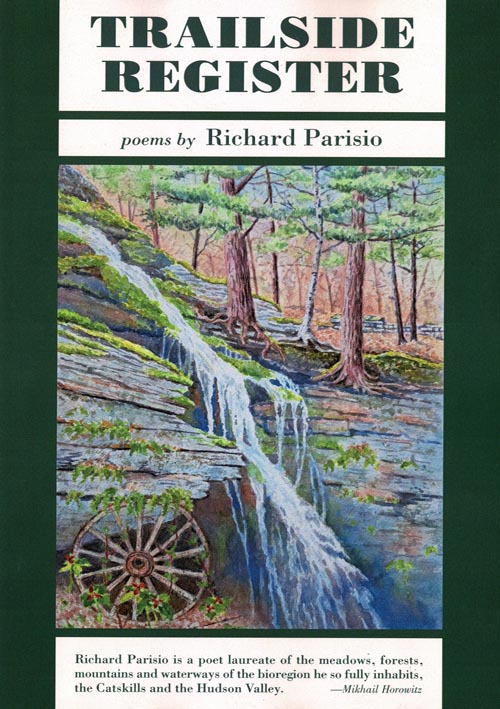
With 94 pages and a trim size of 6 by 9 inches, this book includes cover art and black-and-white illustrations by Mira Fink.
About the Author:
Richard Parisio worked for twenty-five years as an environmental educator in the Catskills and Hudson Valley for the New York State Department of Environmental Conservation. He also wrote a weekly nature column for the New Paltz Times. He has taught thousands of children and adults about everything from ants to monarch butterflies to John Burroughs, the once-famous Catskills nature writer and friend of Walt Whitman and Theodore Roosevelt. Parisio’s earlier poetry chapbook is The Owl Invites Your Silence.
Advance Praise:
“Like his great predecessor, the English Romantic nature poet John Clare, Richard Parisio is a poet laureate of the meadows, forests, mountains, and waterways of the bioregion he so fully inhabits, the Catskills and the Hudson Valley. His eye and ear are deeply engaged with the minute particulars of the natural world—with salamanders ‘whose silent passage breathes a kind of prayer,’ or mockingbirds ‘flinging mad arias of desire,’ or the call-and-response of ‘windchimes and wren song.’ But he also trains his clear, sharp focus on the fraught human relationship to that world of essential, yet increasingly endangered sovereignty—that world of trees, bees, and beasts that is inextricably interwoven with ours.” ~Mikhail Horowitz
